
As AI agents become more capable and autonomous, the focus is shifting from what these systems can do to how they can be deployed safely. Operating system developers are increasingly working to create secure environments where AI-powered agents can operate with clear restrictions, controlled permissions, and enterprise-level oversight. The goal is to ensure that intelligent software can perform complex tasks without creating new security risks.
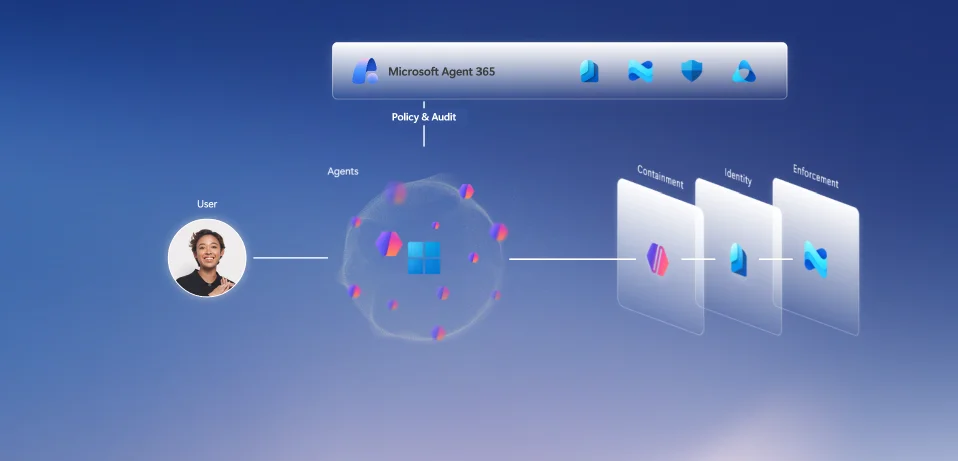
One of the latest developments in this area is a policy-driven execution framework designed to provide a secure foundation for AI agents running on desktop and cloud-connected environments. Rather than requiring developers to manually configure isolation mechanisms, the framework allows administrators to define policies that determine what resources an agent can access, what actions it may perform, and how it interacts with the surrounding system.
The architecture relies on multiple layers of isolation. Standard workloads can operate within process-level containment, while more sensitive scenarios can leverage separate user sessions and identities. Future enhancements are expected to introduce micro virtual machines for higher-risk activities and support for Linux-based container environments when specialized toolchains are required. Additional plans include integration with cloud-hosted desktop environments, enabling agents to execute workloads remotely while remaining subject to centralized governance policies.
A key principle behind this strategy is that security should be built directly into the operating system rather than added as an afterthought. By combining containment, identity management, monitoring, and policy enforcement, organizations gain greater visibility into how agents behave and what resources they access. Centralized management platforms can then distribute policies across large environments while security tools provide auditing, threat detection, and compliance reporting.
This approach builds on years of investment in platform security technologies. Features such as secure startup processes, passwordless authentication, live security patching, memory protection mechanisms, and preparations for post-quantum cryptography create a foundation that intelligent agents can inherit. Security systems can also help detect threats unique to AI workloads, including prompt manipulation attempts and unauthorized tool usage.
Industry analysts have noted that one of the framework’s most interesting aspects is its ability to abstract multiple isolation technologies behind a single configuration model. Developers can describe desired security policies without needing to manage every underlying containment mechanism individually. This simplifies deployment while allowing security teams to maintain consistent controls across environments.
Despite the enthusiasm surrounding these advancements, experts have cautioned that the technology remains in an early stage. Some implementations are still considered experimental, and certain protections should not yet be viewed as complete security boundaries. Researchers have highlighted areas where policy configurations may be overly permissive and where network restrictions require further refinement. These concerns are particularly important because compromised agents could potentially expose sensitive data through external communications.
The broader industry is pursuing similar goals through a variety of technical approaches. Several organizations are developing secure runtimes specifically designed for autonomous agents, combining sandboxing technologies with declarative policies that restrict file access, network communication, and process behavior. These platforms aim to ensure that agents remain productive while preventing unauthorized actions or data leakage.
Enterprise-focused solutions are increasingly combining confidential computing technologies, hardened containers, and zero-trust security models to protect AI workloads across hybrid and multi-cloud environments. The emphasis is often placed on hardware-backed isolation and strict access controls that remain effective even if an agent behaves unexpectedly.
Container orchestration platforms have also become an important part of the conversation. New tools are emerging that isolate AI workloads inside hardened containers or lightweight virtualized environments. These systems are designed to execute untrusted code safely while enforcing strict rules around permissions, filesystem access, and network connectivity.
Cloud providers are likewise experimenting with sandbox technologies based on micro virtual machines. In these environments, each AI workload operates within its own isolated execution space, reducing the risk that a compromised process could affect other applications. Many of these designs adopt a default-deny networking model, requiring explicit approval before outbound communication is permitted.
On Linux-based systems, developers are building security frameworks using native kernel technologies such as namespaces, cgroups, seccomp filters, Landlock policies, and eBPF monitoring. These tools allow administrators to create highly granular controls around individual agents without modifying the agents themselves. Instead of introducing entirely new security layers, this approach extends existing operating system capabilities to address the unique challenges posed by autonomous software.
As the AI ecosystem continues to evolve, it is becoming clear that no single security model has emerged as the industry standard. Different platforms are exploring different combinations of policy management, virtualization, sandboxing, and hardware-backed isolation. While newer frameworks offer promising approaches to agent governance and containment, many remain under active development and should be evaluated carefully before being trusted with critical workloads.
For organizations planning to deploy AI agents in production environments, the most important takeaway is that security must be treated as a foundational requirement rather than a feature added later. Whether implemented through operating system controls, virtualized sandboxes, or kernel-level protections, robust containment and governance will play a central role in the future of autonomous computing.