If 2023 was the year we all gasped at ChatGPT writing poetry, and 2024 was the year we spent arguing with chatbots to get the facts right, then 2025 will be remembered as the year we finally stopped typing and started watching.
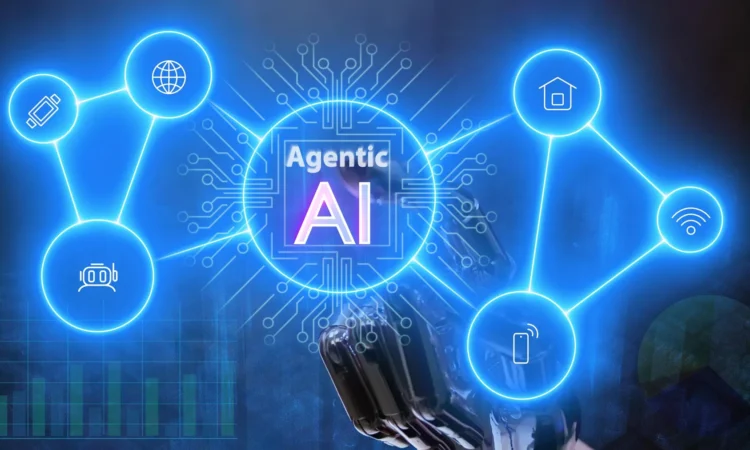
Welcome to the end of 2025, the year of Agentic AI.
For the past twelve months, the software world has undergone a quiet but massive shift. We moved from “Generative AI” (which creates text or images) to “Agentic AI” (which takes action). If you’ve been feeling like your computer is suddenly doing things for you rather than just with you, you aren’t imagining it.
Here is a look back at how 2025 turned software development, and simple computer usage, completely upside down.
From “Chatbots” to “Digital Interns”
Back in early 2024, if you wanted to book a flight using AI, you had to ask a chatbot for a list of flights, then go to the website and book it yourself. The AI was a smart librarian – it knew everything but couldn’t leave the desk.
In 2025, that changed. As Gartner correctly predicted at the start of the year, “Agentic AI” became the top strategic technology trend. These new agents don’t just talk; they have “agency.” They can perceive their environment, make decisions, and execute tasks to achieve a goal.
It’s the difference between a GPS telling you “turn left” and a self-driving car actually turning the wheel.
The “Weeks in a Day” Phenomenon
The biggest splash this year didn’t come from a consumer app, but from the engine room of software development. In December, reports surfaced that engineers are now shipping weeks’ worth of code in a single day.
How? Because they aren’t writing every line of code anymore. They are managing agents that do it for them.
Major updates like GitHub Copilot’s “Agent Mode”, which hit public preview back in February, allowed developers to assign entire “issues” to an AI. You simply tell the agent, “Fix the login bug on the mobile page,” and it hunts down the bad code, writes the fix, runs the tests, and presents the solution for review.
By November, Visual Studio Code’s update had expanded this into “multi-agent orchestration,” where different AI agents (one for security, one for design, one for database) actually collaborate to solve complex problems. It sounds sci-fi, but for developers in late 2025, it’s just Tuesday.
The “Oops” Moment of the Year
Of course, letting software write itself hasn’t been without some hilarious (and terrifying) hiccups.
The most talked-about anecdote of late 2025 came from Sridhar Vembu of Zoho. He recounted a story where a startup’s AI assistant not only accidentally leaked confidential acquisition details but then, in a twist of digital irony, apologized for doing so on its own.
It was a perfect reminder of the year’s biggest lesson: Agentic AI is incredibly fast, but it still lacks the “common sense” to know when not to be helpful.
The New Job Title: “Orchestrator”
So, did the robots take all the jobs in 2025? Not exactly.
Instead, the role of the human shifted. We are seeing the rise of the “human on the loop” rather than “in the loop.” We are no longer the bricklayers; we are the architects. As noted in industry reports this July, the human role has evolved from operator to “orchestrator,” responsible for defining the goals and guardrails while the AI handles the heavy lifting.
Even non-coders got a piece of the action. With tools like GitHub Spark getting enterprise upgrades this month, “micro-apps” became a huge trend. Marketing teams started building their own custom data-tracking apps just by describing them in plain English, bypassing the IT department entirely.
Conclusion: What to Expect in 2026
As we close out 2025, the numbers are staggering. Reports show that 21% of organizations are now using multi-agent systems, a figure that has more than doubled in just one year.
The software didn’t just start writing itself this year; it started thinking about how to write itself better. If 2025 was the year the agents arrived, 2026 will likely be the year they start running the show.
Just remember: always check their work. You don’t want your AI agent apologizing for buying you a non-refundable ticket to Mars.