RAM manufacturers love a good hype cycle. DDR5 barely hit mainstream adoption – only about 30% of PCs use it in early 2026 – and the industry already bombards us with DDR6 promises. Blazing speeds. Revolutionary architecture. The future of computing. But here’s the question nobody wants to answer honestly: do you actually need it?
Where DDR6 Actually Stands in January 2026
Let’s cut through the marketing. DDR6 isn’t coming to your local computer store anytime soon. JEDEC finalized the DDR6 specification in late 2025, but specifications and actual products are different things.
Current DDR6 timeline:
| Phase | Date | Status |
| Specification finalized | Q4 2025 | Complete |
| Platform testing | 2026 | In progress |
| Server deployment | 2027 | Planned |
| Consumer availability | Late 2027-2028 | Projected |
Samsung, SK Hynix, and Micron have working prototypes. They’re conducting validation tests with Intel, AMD, and NVIDIA. But platform testing takes time. Consumer-grade DDR6 modules won’t appear before late 2027, and mainstream adoption probably won’t happen until 2028 or later.
Translation: DDR6 is at least two years away from your gaming rig.
The Spec Sheet Showdown
Numbers look impressive on paper. Let’s see what they actually mean.
| Feature | DDR5 | DDR6 |
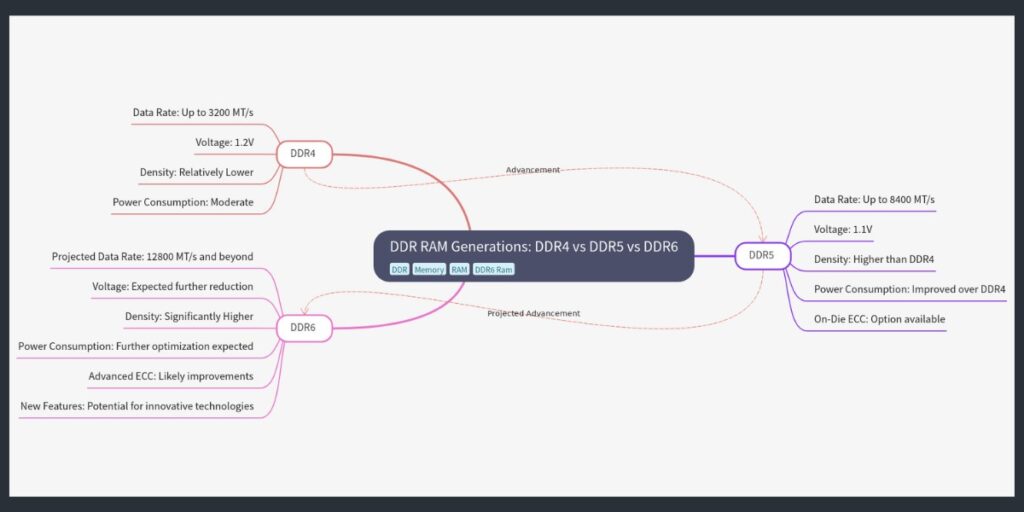
| Base speed | 4800 MT/s | 8800 MT/s |
| Top speed | 8400 MT/s | 17,600 MT/s |
| Voltage | 1.1V | <1.1V |
| Channels per module | 2x 32-bit | 4x 24-bit |
| Bandwidth (per module) | 64 GB/s | 128-136 GB/s |
DDR6 doubles DDR5’s top-end speeds and nearly doubles bandwidth. The shift to four 24-bit sub-channels instead of two 32-bit channels represents a fundamental architecture change, not just faster chips.
But here’s what the spec sheets won’t tell you: most applications can’t use that bandwidth. Your email client doesn’t care if RAM runs at 8000 MT/s or 17,000 MT/s. Even demanding games often see minimal differences between mid-range and high-end DDR5.
Real-World Performance: Where DDR5 Already Wins
Techspot tested DDR5 against DDR4 across 22 games. DDR5 averaged 4% faster at 1080p and 10% faster for 1% lows – the stutters that actually ruin gaming experiences. That’s measurable improvement in scenarios people actually encounter.
Applications where DDR5 delivers:
- Gaming at high refresh rates (144Hz+)
- Large open-world games with streaming assets
- Video editing with 4K+ timelines
- 3D rendering with complex scenes
- Virtual machines running simultaneously
Applications where DDR5 barely matters:
- Office productivity (Word, Excel, email)
- Web browsing and streaming media
- Photo editing with reasonable file sizes
- Casual gaming at 60 FPS
- General multitasking under 16GB usage
For most people, DDR5 provides noticeable benefits over DDR4. The jump from DDR5 to DDR6 won’t feel as dramatic unless you’re running AI models, processing massive datasets, or engaging with 8K video workflows.
The Price Reality Nobody Mentions
Remember DDR5’s launch in 2021? Prices were absurd. A 32GB DDR5 kit cost $300-400 when equivalent DDR4 sold for $100-150. Early adopter tax hit hard.
Now multiply that problem. DDR6 will launch even more expensive. Industry estimates suggest over $300 for a basic 32GB kit, possibly exceeding $500 for high-performance modules. And that’s just RAM. You’ll also need a new motherboard and CPU since DDR6 won’t work with current platforms.
“Upgrading to DDR6 in 2026 may not be worth the cost unless you’re pushing AI or 8K workflows. Upgrading to DDR5 now offers better performance and future-proofing.” – Industry analysis, October 2025
Meanwhile, DDR5 prices have normalized. A quality 32GB DDR5-6000 kit costs $70-100 in early 2026. That’s the sweet spot: mature technology at reasonable prices delivering real performance gains.
The Compatibility Trap
Here’s the uncomfortable truth about RAM upgrades: you can’t just swap modules. DDR6 requires entirely new platforms.
What you’ll need for DDR6:
- New CPU (AMD Zen 6 or Intel Arrow Lake successors)
- New motherboard with DDR6 slots
- Potentially new cooler if socket changes
- The DDR6 RAM itself
You’re looking at a $700-1000 upgrade minimum, not a $300 RAM purchase. Compare that to dropping $100 on DDR5 for your existing system.
DDR5’s recent mainstream adoption means many users will stick with it through 2027. Only 30% of PCs use DDR5 in early 2026, which means 70% still run DDR4. Most people haven’t even made the DDR5 jump yet.
Who Actually Needs DDR6
Let’s be specific about genuine DDR6 use cases:
- AI and machine learning researchers – Training large language models requires massive memory bandwidth. DDR6’s 128-136 GB/s bandwidth significantly accelerates data feeding to processors.
- Data scientists processing massive datasets – Operations on multi-terabyte datasets bottleneck on memory speed. DDR6’s quad-channel architecture improves parallel data access.
- Professional video editors working in 8K – Scrubbing through 8K timelines demands enormous bandwidth. DDR6 reduces preview lag and export times.
- High-frequency traders – Microseconds matter. DDR6’s lower latency combined with higher speeds provides measurable advantages in algorithmic trading.
- Researchers running complex simulations – Weather modeling, fluid dynamics, molecular simulations – these workloads push memory systems to limits where DDR6’s capabilities matter.
Notice what’s missing from that list? Gaming. Web development. Office work. Photo editing. Content creation. Music production. The applications 95% of computer users actually do.
The Gaming Reality Check
Gamers drive enthusiast hardware markets, so let’s address this directly: DDR6 won’t transform your gaming experience.
Modern games are overwhelmingly GPU-limited, not RAM-limited. A faster graphics card delivers bigger performance jumps than faster RAM. DDR5-6000 already provides enough bandwidth for current and near-future games.
Some argue that DirectStorage 3.0 and asset streaming in next-gen engines will demand more memory bandwidth. Maybe. But by the time games actually require DDR6, the technology will have matured and prices will have dropped.
Early adopters pay premium prices to beta test hardware. Let someone else do that.
What Makes Sense Right Now
- If you’re building a PC in early 2026:
Choose DDR5. It’s mature, affordable, and provides genuine performance benefits over DDR4. DDR5-6000 or DDR5-6400 kits offer the best price-to-performance ratio. Spending extra on DDR5-7200+ delivers diminishing returns.
- If you’re running DDR4:
Consider upgrading to DDR5 if you’re also upgrading your CPU and motherboard. Don’t upgrade RAM alone – you can’t use DDR5 without a compatible platform.
- If you’re already using DDR5:
Keep it. Seriously. You won’t notice DDR6’s benefits unless your workflow explicitly demands capabilities beyond what DDR5 provides.
- If you’re desperate for cutting-edge tech:
Wait until late 2027. Let others pay the early adopter tax. Let manufacturers work out bugs. Let prices stabilize. Buy DDR6 when it’s actually good value.
The Bottom Line
DDR6 represents genuine technological advancement. The architecture changes and performance improvements are real. But technological advancement doesn’t automatically mean you need it.
Most computer users gain nothing from DDR6 in 2026 or even 2027. DDR5 already provides excellent performance at reasonable prices. It handles gaming, content creation, productivity, and multitasking without breaking a sweat. The jump from DDR4 to DDR5 delivered meaningful improvements. The jump from DDR5 to DDR6 will mostly deliver bigger price tags.
Save your money. Buy DDR5 now or stick with what you have. When DDR6 actually matters – when software demands it, when prices normalize, when platforms mature – you’ll know. Until then, the “latest RAM standard” is just that: the latest, not the necessary.